Articles, Interviews & Speeches
- Articles
- Interviews
-
Speeches »
- Archbishop - Religious Faith and Human Rights
- The Spiritual and the Religious: Is the Territory Changing?
- Archbishop's Easter Message
- Archbishop's Holy Week Lecture: Faith & History
- Holy Week: Faith and History Questions & Answers Session
- Archbishop's Holy Week Lecture: Faith & Politics
- Holy Week: Faith & Politics Questions & Answers Session
- Archbishop's Holy Week Lecture: Faith & Science
- Holy Week: Faith and Science Questions & Answers Session
- 'Risen Indeed': The Resurrection in the Gospels
- Questions & Answers: 'Risen Indeed', the Resurrection in the Gospels
- 'Risen Today': The Resurrection as Good News Now
- Questions & Answers: 'Risen Today', the Resurrection as Good News now
- Archbishop speaks to Scientists at Sanger Institute
- Faith in the Future
- 'Faith, Reason and Quality Assurance - Having Faith in Academic Life'
- 'Faith, Reason and Quality Assurance - Having Faith in Academic Life' Questions & Answers Session
- 'What Difference Does it Make?' - The Gospel in Contemporary Culture
- What Difference Does it Make? - The Gospel in Contemporary Culture Questions & Answers Session
- Archbishop introduces Professor Bernard McGinn
- Archbishop's farewell tribute to Bishop of Truro
- Archbishop's farewell tribute - Bishop of Sheffield
- The Archbishop's Speech on Gambling, at the General Synod
- Presidential Address to the opening of General Synod
- Archbishop's Lecture - Civil and Religious Law in England: a Religious Perspective
- Archbishop's lecture - Religious Hatred and Religious Offence
- Archbishop's Holocaust Memorial Day Statement
- Archbishop's Liverpool lecture: Europe, Faith and Culture
- 2007 speeches archive
-
2006 speeches archive »
- O Little Town of Bethlehem - A Pause For Thought
- Rome Lecture: 'Secularism, Faith and Freedom'
- Rome - Archbishop's Greeting to Pope Benedict
- 'Benedict and the Future of Europe' - Speech at St Anselmo in Rome
- China - 'What is a University?' Speech Given in Wuhan
- 9/11 Five Years On - Thought for the Day
- Speech on Penal Policy - Worcester Cathedral
- Women in the Episcopate - General Synod Debate
- Speech to General Synod on Women Bishops
- Archbishop's Address to the Synod
- The Challenge and Hope of Being an Anglican Today: A Reflection for the Bishops, Clergy and Faithful of the Anglican Communion
- Climate Change- a Moral Issue. Address to the Tyndall Centre
- Intense Activity Elsewhere: Good Friday Thought for the Day, Radio 4
- Easter Surgery - Pause for Thought with Terry Wogan, BBC Radio 2
- The Church: God's Pilot Project
- Justice and Rights - Fifth Building Bridges Seminar, Opening Remarks.
- Church Schools: a National Vision
- Contribution given at the Sudan Inter-Religious Council
- World Council of Churches Assembly - Globalisation, Economics and Environment
- What We Mean By Christian Identity - World Council of Churches Address
- Speeches to General Synod on Women Bishops
- Bicentenary of the Act for the Abolition of the Slave Trade - Speech to General Synod »
- General Synod Women Bishops' Debate - Archbishop's Contributions
- Mansion House Speech : Antidote to Blasphemy v. Free Speech Arguments is Respect and Civility
- Dietrich Bonhoeffer Memorial, Poland - Archbishop's Speech
- Inaugural Meeting of the Christian-Muslim Forum: Archbishop's Speech
- 2005 speeches archive
- 2004 speeches archive
- 2003 speeches archive
- 2002 speeches archive
Bicentenary of the Act for the Abolition of the Slave Trade - Speech to General Synod
Wednesday 08 February 2006
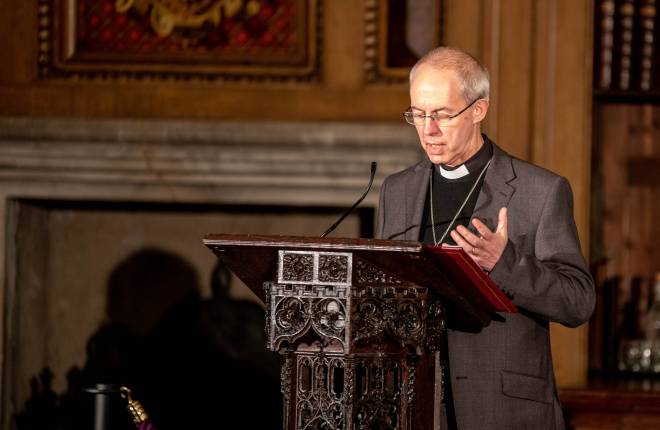
The Archbishop made the following contribution during the General Synod debate on commemorations for the bicentenary of the 1807 Act to abolish the transatlantic slave trade. He sets out the reasons why an apology from the Church of England is necessary.
As you've already heard, a great deal has already been said about apology. And there are those commentators who will claim that apology is either unnecessary or, because it is cost-free, means nothing. They claim that it's unnecessary because, to use that most maddening and tired of clichés, it's just an example of political correctness, it's cost-free because it's words only. I want to speak in support of Simon Bessant's amendment because I believe that what we're talking about is both necessary and costly.
I have two points to make. The first is something that Rose Hudson Wilkin has already alluded to: we're talking about the Body of Christ. Over the weekend I spent a couple of days taking part in the celebrations for Bonhoeffer's centenary and one of the texts I was given to speak about was from a letter of Bonhoeffer to Bishop Bell of Chichester, in which he spoke of how in the Body of Christ, the shame of different parts of the body was shared, as well as the joy. The Body of Christ is not just a body that exists at any one time; it exists across history and we therefore share the shame and the sinfulness of our predecessors and part of what we can do, with them and for them in the Body of Christ, is prayerful acknowledgement of the failure that is part of us not just of some distant 'them'.
Some years back, when we were first discussing issues in the church about HIV and AIDS, the potent slogan was coined 'The Body of Christ has AIDS'. Similarly, we have to say 'The Body of Christ has been and is in slavery', but also that 'The Body of Christ has been involved in slave-owning'. Apology is about that; it is not about trying to gratify some sense of wanting to wipe the record clean. On the contrary, it's part of what we are as a Christian community; corporate acknowledgement of repentance, which like every such acknowledgement, ought to stimulate us to action, which is why it's costly.
The second point I want to make, briefly, is that in the world around us we see countless examples of how an unacknowledged and unhealed past imprisons us in the present and for the future. We see it in international, inter-ethnic and inter-faith tensions and if there is one thing that the Gospel of Christ says to us is that it is possible, in acknowledging the past, to open it to the healing power of Christ. The freedom, and I'd underline that word with all of its ironies in this context, the freedom to repent and acknowledge and open ourselves up to the grace of God is part of the Good News.
To speak here of repentance and apology is not words alone; it is part of our witness to the Gospel to a world which needs to hear that the past must be faced and healed and cannot be ignored. So if we accept, as I hope we shall, this amendment, I trust we'll do so in a spirit and conviction that by so doing we are actually discharging our responsibility to preach Good News, not simply to look backwards in awkwardness and embarrassment, but to speak of the freedom we are given to face ourselves, including the unacceptable regions of ourselves and our history.
© Rowan Williams 2006